
A walk through the whole Bible on a single thread — in the order of the Hebrew canon, and where it finally lands.
It’s 3am and you’re awake again. Not anxious about anything you could name — just awake. You had the early night. You took the holiday and came home as tired as you left. We tend to treat this as a scheduling problem: more sleep, a lighter week, a better morning routine. The Bible treats it as something far older and far deeper, and it has a word for what we are actually missing.
The word is rest — and in the Bible, rest is not first the absence of work but the presence of God in a world made whole. It is what we were made for, what we lost, and what God spends the whole of Scripture bringing his people home to. The theme runs like a golden thread from the first page to the last. I have prayed for rest and still woken up tired; maybe you have too — so it is worth following the thread all the way through. We will trace it through the Hebrew Bible in its own three-part order: the Law, the Prophets, and the Writings, the way Jesus knew it (Luke 24:44). Watch where it ends — not with Malachi but with Chronicles, God’s people still leaning forward, still waiting. Watch how the longing builds. Then watch where it lands.
In the beginning, a day off (the Law)
In the Law, rest is a gift before it is ever a command: God rests first, then hands his seventh-day rhythm to a rescued people, and points them toward a homeland of rest.
Genesis. The story opens not with a command to rest but with God himself doing it: “God rested on the seventh day from all his work” (Genesis 2:2). This is not God recovering from exhaustion — the seventh day is the crown of creation, the moment he settles into a world that is finished and good. And we were made for it. Humanity arrives on day six, so our first full day is a day of rest in God’s company. Rest, from the very beginning, is not mainly the absence of work but the presence of God in a world made whole. That is what we lost in Eden.
Exodus. When God rescues Israel from slavery, one of his first gifts is the Sabbath. Slaves don’t get days off; sons and daughters do. So the seventh-day rhythm of creation is handed back to a redeemed people as sheer grace (Exodus 16; 20:8–11). Each week they stop and remember: we are not slaves any more, and the world does not rest on our shoulders. And at the book’s close, the tabernacle is built — a little piece of Eden restored, where God dwells among his people again. Presence and rest belong together.
Leviticus. The pattern now spreads through the whole of life. The festivals are built around sevens (Leviticus 23); every seventh year the land itself lies fallow, and every fiftieth — the Jubilee — debts are cancelled and family land returned (Leviticus 25). Rest is not just for tired people but for the soil, the economy, the poor. A whole society, shaped around the rhythm of grace.
Numbers. The goal of the long journey is named simply as rest — a secure home with God at the centre. But Numbers leaves Israel on the very threshold, looking across the Jordan at a rest that is real, and near, and not yet entered. The book ends leaning forward.
Deuteronomy. Moses names the hope plainly: “you have not as yet come to the rest and to the inheritance” (Deuteronomy 12:9) — but you will, when God gives you rest from your enemies in the place he chooses. The promise is set. The only question is whether Israel will trust the God who made it.
Rest won — and thrown away (the Former Prophets)
In the Former Prophets, Israel is finally given the promised rest in the land — and then, leader by leader and king by king, throws it away.
Joshua. At last, a taste of it: “the LORD gave them rest on every side” (Joshua 21:44). Israel is in the land, the enemies subdued, the dream apparently arrived. And yet — as the New Testament will quietly point out — Joshua’s rest was real but not final. The deepest rest was still ahead (Hebrews 4:8).
Judges. Then a refrain begins to toll like a bell: “the land had rest forty years” (Judges 3:11; 5:31; 8:28). For a while the rhythm holds — and then, as the book spirals downward, the bell simply stops ringing. By the end, no one is at rest at all.
Samuel. Rest returns, now tied to a king. “The LORD had given him rest from all his enemies,” we read of David (2 Samuel 7:1) — and out of that rest comes God’s promise of an everlasting throne and a house where he will dwell. Yet even David falls, and the book teaches its quiet lesson: lasting hope rests not on the king’s performance but on God’s covenant.
Kings. For one golden moment it all seems recovered. Under Solomon, God gives Israel “rest on every side” (1 Kings 5:4); the temple is built; Solomon blesses the God who “has given rest to his people” (8:56). It looks like Eden regained. And then, slowly and catastrophically, it is thrown away — until the people are deported, the land lost, the temple burned. This is the story of fulfilment forfeited.
A deeper rest promised (the Latter Prophets)
In the Latter Prophets, into the wreckage of exile, God promises a rest deeper than the land ever gave — one that reaches all the way down to the heart.
Isaiah. Into the ruins Isaiah speaks of a coming King on whom “the Spirit of the LORD shall rest” (Isaiah 11:2) — a root of Jesse who will be a resting-place even for the nations (11:10). He pleads with a people who will not listen: “in returning and rest you shall be saved” (30:15) — this is the rest; give rest to the weary (28:12) — but they would not hear. Read that again: the rest was offered, freely, and they said no.
Jeremiah. As judgment looms, God still calls: “ask for the ancient paths… and find rest for your souls” (Jeremiah 6:16). Hold that sentence in your mind — Jesus will pick up these very words.
Ezekiel. When the shepherds of Israel have scattered the flock, God says he will come and shepherd them himself: “I will make them lie down” in safety (Ezekiel 34:15). And he promises what no law could achieve — a new heart, his own Spirit within them (36:26–27), and his glory returning to dwell with them for ever (43; 48:35). The rest is coming, and it will go all the way down to the heart.
The Twelve (the Minor Prophets). Through judgment, the same hope keeps breaking out. Micah pictures a day when everyone sits “under his vine and under his fig tree” with no one to make them afraid (Micah 4:4) — Solomon’s lost peace, now made universal and permanent. Zephaniah dares to say God himself “will quiet you by his love” (Zephaniah 3:17). The Day of the LORD will clear the ground for a kingdom of peace.
Learning to wait (the Writings)
After the exile the story does not so much advance as ache. A different kind of book takes over — songs and stories for people learning to live in the gap between a rest promised and a rest not yet given. They do not pretend the ache away. They teach us how to wait.
Psalms. Israel’s prayer book holds both halves of the truth in a single breath. “They shall not enter my rest” (Psalm 95:11) — and yet, “Today, if you hear his voice…” (95:7). It calls God’s chosen temple “my resting place for ever” (132:14), and teaches the weary heart to say, “Return, O my soul, to your rest” (116:7). Even its most famous song leads us beside still waters and restores the soul (Psalm 23).
Job. Here is rest at its rawest — the rest of a sufferer who has lost it. “I have no rest,” he cries into the dark (Job 3:26). He refuses both tidy answers and flat despair, wrestling God to his face — and still, from the bottom, he gasps, “I know that my Redeemer lives” (19:25).
Two quieter voices sing alongside. Proverbs promises that a life ordered around the fear of the LORD lies down and sleeps sweetly (Proverbs 3:24); the Song of Songs offers, in the language of love, a glimpse of the at-home-ness we were made for. Small rests, both — but pointing the same direction as everything else.
Ruth. In a small domestic story, an old woman seeks “rest” — menuchah, a settled home and security — for her widowed daughter-in-law (Ruth 1:9; 3:1). She finds it through a kinsman-redeemer named Boaz, and the baby that follows turns out to be the grandfather of King David. Even the smallest rest is pointing somewhere.
Ecclesiastes. The Teacher watches people toil endlessly “under the sun” and finds no lasting rest in any of it — no amount of work or wealth can fill the ache. His counsel is humble and real: fear God, and receive each ordinary day as a gift from his hand (Ecclesiastes 12:13).
Lamentations. This is the sound of rest entirely lost. Of the exiled city it says simply: “she finds no resting place” (Lamentations 1:3). And yet the book is a model of faith — grieving honestly while still clinging to promises it cannot yet see kept.
Esther. Here the theme turns sharp. Disaster falls “on the seventh day” of the king’s feast (Esther 1:10) — an empire that has borrowed God’s rest-day but kept only the drunkenness. Then the villain makes his move. Haman urges genocide by arguing that it is not in the king’s interest to give these people rest (3:8) — and the Hebrew word he reaches for is nuach, the old covenant word for the very peace God had promised his people all the way back in Deuteronomy. The enemy of God’s people sets himself up, quite deliberately, as the enemy of their rest. So watch what happens when deliverance comes: the word that rings out across the provinces is the one Haman tried to deny them — nuach, “rest from their enemies” (9:16). The thing he schemed to prevent is the thing God grants. And yet it is rest with the edges left raw: the true King has not come, the empire grinds on, and the book ends having stirred a longing it cannot satisfy.
Daniel. Above the chaos of rising and falling empires, Daniel is handed a quiet, astonishing promise for the faithful who die before the end: “you shall rest and shall stand in your allotted place at the end of the days” (Daniel 12:13). Beyond exile, beyond even death, there is a rest waiting — and a resurrection to enjoy it (12:2).
Ezra–Nehemiah. The people do return and rebuild — but the glory does not come back, the hearts are not changed, and they confess that they are “slaves” still in their own land (Nehemiah 9:36). The longed-for rest has not arrived.
Chronicles. And so the Hebrew Bible ends — not with Malachi, but here. The Chronicler retells the whole story from Adam onward, with the temple at its heart: the ark coming into “its resting place,” David’s son Solomon named “a man of rest” (1 Chronicles 22:9), even the exiled land at last “enjoying its Sabbaths” (2 Chronicles 36:21). Then the closing words of the Old Testament: Cyrus’s decree, “let him go up.” The Bible shuts with God’s people poised on the doorstep, the true rest still ahead, waiting for the one who can finally bring them home.
Home at last: rest has a name (Christ)
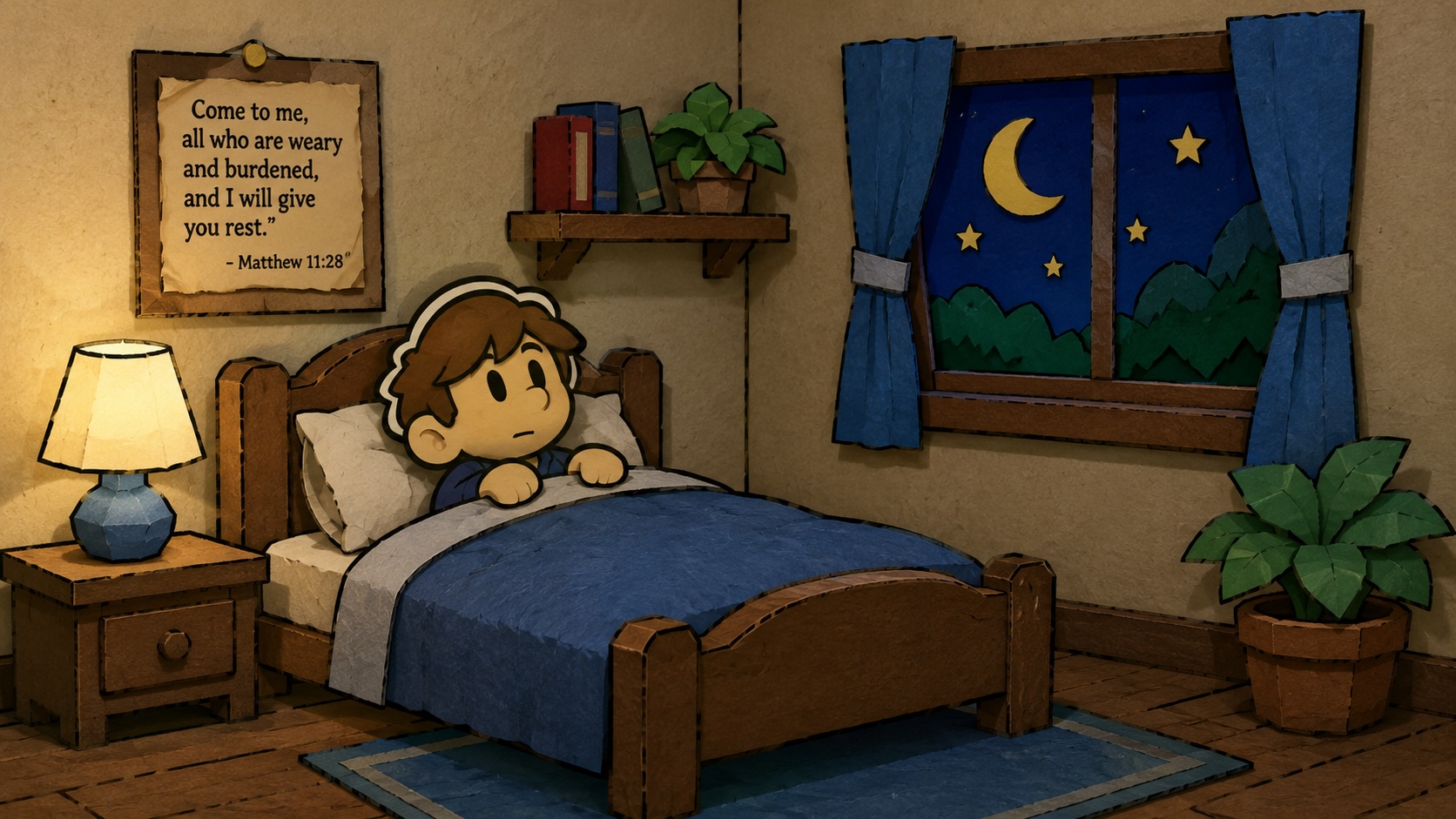
Into that long ache walks Jesus, and almost the first thing he says gathers up the whole story: “Come to me, all who are weary and heavy-laden, and I will give you rest” (Matthew 11:28). Listen closely and you can hear Jeremiah’s ancient call — find rest for your souls — now spoken by the one who can actually give it. It is the answer to Haman’s sneer and Job’s protest, to Koheleth’s weariness and the Psalmist’s “today,” all at once.
John’s Gospel shows us the tragedy and the triumph. Again and again Jesus heals on the Sabbath, and again and again the religious leaders rage — because they would rather cling to a world they can control than step into the rest standing in front of them. But on the cross Jesus speaks the word the whole canon has been waiting for: “It is finished” (John 19:30). Like God surveying a completed creation on the seventh day, the Son finishes the work of new creation — and the way back into God’s rest is open at last.
So is that the end of the thread? Not quite — and here it touches your Monday morning. The letter to the Hebrews picks up Psalm 95 and makes a thrilling claim: “There remains a Sabbath rest for the people of God” (Hebrews 4:9). In Christ we have already reached the doorway — and yet the fullness is still ahead. We live in the “today”: resting in finished work, and pressing on towards the rest that is coming, when God will finally and fully dwell with his people (Revelation 21:3).
So your restlessness is not a fault to be managed. It is a kind of homesickness — for the seventh day, for the garden, for the presence of God you were made to enjoy. The whole Bible has been telling you so.
The next time you are lying awake at 3am, too tired to name what is missing — that is not a glitch in your wiring. It is the ache the whole story has been describing. Only now you know its name; you know the work is finished; you know the door is open.
Come to him. Today, if you hear his voice.
Frequently asked questions
What does the Bible say about rest?
Rest in the Bible is less the absence of work than the presence of God in a finished, ordered world. It begins at the seventh day of creation, becomes the Sabbath gift and the Promised Land, is forfeited in exile, and is finally given by Jesus, who says, “Come to me… and I will give you rest” (Matthew 11:28).
Is the Sabbath still binding for Christians?
The New Testament presents Christ as the true rest the Sabbath always pointed toward (Hebrews 4:9–10). Christians are not under the old Sabbath law, but the pattern of stopping to trust God remains wise and good. The deepest rest is now found in Jesus’ finished work rather than in keeping a particular day.
What does Jesus mean by “I will give you rest”?
In Matthew 11:28 Jesus offers rest for the soul — relief from striving to earn God’s acceptance. He echoes Jeremiah’s call to “find rest for your souls” (Jeremiah 6:16) and presents himself as the one who gives what the law could not. The rest is received by coming to him, not by trying harder.
What is the “Sabbath rest” that remains in Hebrews 4?
Hebrews 4:9 says “there remains a Sabbath rest for the people of God.” It means the rest God intended from creation is still open, and is entered through faith in Christ. Believers enjoy it in part now (“today”) and will know it fully in the new creation.
Why does the Hebrew Bible end with Chronicles, not Malachi?
In the Hebrew ordering, Chronicles comes last, closing with Cyrus’s decree, “let him go up” (2 Chronicles 36:23). The effect is a Bible that ends leaning forward — God’s people on the doorstep of a rest not yet entered, waiting for the one who can finally bring them home.