
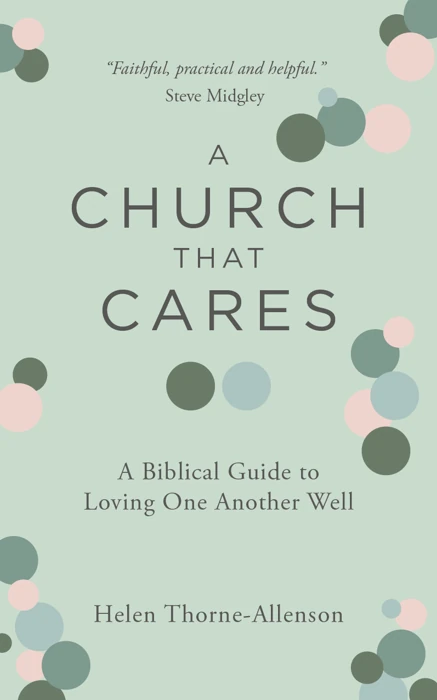
Helen Thorne-Allenson’s A Church That Cares is right that churches can preach well and still leave people alone. But four passages it never opens would have given it a better answer than the one it builds.
The sermon was faithful. The coffee was hot. She left with the same grief she brought in, and nobody asked.
I have preached that sermon. If you preach, you probably have too.
A Church That Cares (The Good Book Company, 2026) exists because that morning is real, and Helen Thorne-Allenson is right to refuse it. Her answer is that a culture of care must be deliberately tended, since it will not “come to pass because gospel truth is proclaimed with gentleness.” So where does a caring church actually come from? The New Testament’s answer is that it comes from the word — the same word that made the people in the first place. Care is what a Word-made community does, not a second thing you add once the preaching is sorted.
That is not a quibble about proof-texts. It is the difference between growing something and installing something.
Some of you already run a pastoral care team and want to know whether this book will help. Others of us preach every week and have a quiet suspicion that books like this are written about us. Both of you should read it. Both of you should read it with a pen.
This is not a hit piece, and it is not tribal. Thorne-Allenson writes out of the biblical-counselling world; I write out of a preaching one. If the disagreement were only about which conference we attend, it would not be worth your time. She cites Scripture constantly — this is not a Bible-less book, and much of it is better than what my own tribe usually manages on this subject. The question is narrower and more interesting than tribe: when a verse is asked to fund a culture, is it the verse doing the work?
Start with what she gets right
The best pages in A Church That Cares are its fences — the things it refuses to let a care programme do to people — and I would want my own church to sign several of them.
Churches, she says, “are never places of forced sharing,” and she says it more than once, in chapters where a weaker writer would have let the programme win. She refuses to steamroll the scared. She refuses a congregational coup against reluctant elders. She insists on competency: gifted is not the same as trained, and complex trauma needs more than a willing volunteer with good intentions. She rejects the tacit pressure towards absolute confidentiality as neither wise nor safe — a safeguarding sentence some Christian books still will not write. She says flatly that there is no biblical call to share your life with abusive, coercive or manipulative people.
She is good on Scripture, too, and more so than her critics will expect. The main healthy nutrition of a church, she says, comes through weekly preaching that works book by book and passage by passage. Scripture is sufficient; every page equips. You cannot change a heart. Preach the emotion of the text, not only its propositions. Testimonies exist to point away from the impressive person to the Lord: “He is good, and he is at work.” And when she reaches the cross she does not blink — Jesus took the sins of the world on his shoulders so people like us go free, clothed in his righteousness. That is substitution, stated plainly, in a book about pastoral care. Not every book in this genre bothers.
Then there is Saj, and Saj is the reason I cannot dismiss this book.
Saj hears a keyword in a sentence, finds a verse with that word in it, and applies it. Anxious? Do not be anxious. Grieving? Do not grieve without hope. She describes it as putting a biblical sticking plaster over a gaping wound, and adds — in a detail I could have done without — that he is slightly feared in the church WhatsApp groups. I have been Saj. Someone told me their mother was dying and I had Romans 8:28 out before they had finished the sentence. It was true. It was the wrong thing to say, and I said it because sitting in the silence would have cost me something.
She is also generous about him in a way I would not have been: if only the rest of us had his passion for God’s word. That is the posture of someone who wants to help, not to win. It deserves the same back.
The question underneath the whole book
Every book about church culture is answering one question, whether or not it says so: where does the culture come from?
Thorne-Allenson’s answer is tending. A culture always grows, she says; what grows depends on the teaching, the role-modelling and the relationships you cultivate. Left alone, the vegetable patch goes to weeds and the runner beans tangle with the tomatoes. It is a good image, and there is real pastoral wisdom in it.
The New Testament’s answer is narrower and stranger. The culture comes from the word — not merely as the teaching input to a culture, but as the thing that made the people whose life together the culture is. And this is where the book keeps stepping over its own best material. Four passages would have given it exactly what it wanted, on firmer ground, and none of the four is opened.
Take them in order.
One verse further on (1 Peter 1)
Her first chapter opens with the one-another commands, and the first is 1 Peter 1:22 — love one another deeply, from the heart. Good verse. It is the right place to start.
Read on one sentence. For you have been born again, not of perishable seed, but of imperishable, through the living and enduring word of God. Peter gives the command an engine, and the engine is the word that gave them birth. The love he asks for is possible because of what the word already did to them.
That is not a technicality. It is the whole architecture. The command to love one another arrives attached to an explanation of where the capacity came from, and the explanation is one verse away, and the book does not go there. It takes the imperative and leaves the ground it stands on. She knows the danger — a few chapters later she has a character who needs reminding that “grace is our driver, not law.” The reminder applies to the citation as much as to the counsellor.
The listening chapter’s own verse (James 1)
Chapter six is about listening, and it is one of her better chapters. She is right that accurate words can crush someone who has not been heard. She is right that Scripture is sufficient and comes first. She is right that a question can be an act of love.
In chapter seven, casting the vision, she lists what a loving church looks like. One of the bullets reads “quick to listen to one another with humility.”
That is James. Everyone should be quick to listen, slow to speak, slow to become angry — James 1:19, probably the most quoted verse in the Bible on this subject. The phrase is in her book. The verse is not. Across fourteen chapters, James is cited once, at 5:16, in a list of one-another commands.
And when you read James 1:19 in its own paragraph, look at what brackets it. Just before: he chose to give us birth through the word of truth. Just after: humbly accept the word planted in you, which can save you. The listening James commands is listening to that — the implanted word — and the horizontal patience with each other flows out of the vertical reception. James is not teaching a counselling skill. He is describing what people who have been born by the word are now like.
Which is the very thing this book is trying to describe. Her listening chapter wanted a biblical foundation and the foundation was sitting in the verse her own vision statement was quoting.
Who equips, and for what (Ephesians 4)
Ephesians 4 is the chapter the book leans on hardest, and where you can watch the method work in slow motion.
Chapter two restates Ephesians 4:1 — what does a life worthy of our calling look like? — and offers six marks of a healthy caring church culture, “all drawn from Ephesians 4.” Then the load-bearing sentence. A main role of a church leader, she writes, is to equip believers for works of service, so they know and grow their God-given gifts and the church becomes “the place of love that it is designed to be.”
Now the letter. Verse 1 is a therefore; the calling is chapters 1–3 — election, the new humanity, the temple, resurrection power. The gifts of verse 11 are not abilities but people: apostles, prophets, evangelists, pastors-teachers. Christ ascended and gave persons, and those persons equip the saints so that the saints do the work of ministry. What work? The letter answers within four verses: speaking the truth in love, putting away falsehood, words that build up and give grace. NIV’s “works of service” renders ergon diakonias. In this context, the saints’ ministry is bringing the word.
So what does the book need the verse to fund? A leader coaching people into their gifts so the congregation becomes a caring place. Watch what has to happen for that. “Church leader” stands in for the four offices. And the eye and the hand of 1 Corinthians 12:21 are imported to decode the passage — a different letter, a different argument, a body metaphor doing a different job.
Here is the thing I did not expect to find, and you can check it in ten minutes.
Across the whole book, Ephesians 4 is quoted at verses 1, 2, 3, 7, 12, 13, 14, 15, 22–24, 31 and 32, and as a block at 4:7–12 and 4:7–13. Verse 11 is never quoted on its own, and its four offices are never named — not once in fourteen chapters about how a church is equipped to care. Apostles and prophets do surface in chapter eleven, as the foundation of the building in Ephesians 2:20. True, and a different verse doing a different job.
The sentence telling you who equips the saints, and therefore what they are equipped for, is the sentence the argument moves around. With verse 11 offstage, “works of service” is free to be filled from elsewhere — which is exactly what 1 Corinthians 12 walks in and does.
And notice what she loses by it. Her best instinct in this chapter is anti-clergy-monopoly: the saints do the work, not the staff. Verse 11 is what makes that argument airtight, because it names the four offices as equippers rather than doers. She has the right conclusion and has mislaid the premise.
One move, in different clothes
By now the pattern is visible: refuse a real failure, then treat the refusal as though it settled what the texts are about.
It begins in chapter one with an equation. Love, she writes, “works itself out in the care of others” — and from there the examples start teaching you what the verses meant. Paul shared his life and not only the gospel with the Thessalonians, so love means people feel able to share their lives. The greatest commandments become loving God and loving one another, though Matthew 22 says neighbour, and Matthew has already stretched neighbour to include your enemy. Acts 2 shows that as the church meets, devotes itself to Scripture and shares and cares well, it grows. Luke’s own explanation, three verses later, is that the Lord added to their number. That verse does not appear.
From there the clothes change but the move does not. In chapter seven, preaching is “one-way communication—preacher to congregation—and that is not enough” to communicate something this practical, so a vision evening completes it. In chapter nine, the answer to that charge is not to withdraw it but to make preaching itself “a primary means by which a congregation is cared for.” In chapter eleven the church is like a building, Ephesians 2:21, and Bible-opened discipleship joins a menu alongside care teams and counsellors. In chapter thirteen, John 4 becomes a seven-minute training slot titled “Jesus, the great listener.” In chapter fourteen, Philippians 1:6 — he who began a good work will complete it at the day of Christ — becomes confidence that God will be at work “helping church members to love each other well.”
Each on its own is small. Together they are a direction of travel.
Where I had to correct myself
Reading her properly cost me three objections, and they are worth printing because they show what the book is not.
I had her “staging post” line down as demoting the sermon. In full: a sermon or Bible study is a staging post “in someone’s journey of engaging with the passage” — not the totality. In context that is the opposite of a demotion. She is urging people to keep engaging with the passage afterwards, and citing Colossians 3:16 for members teaching one another rather than relying on the preacher’s words. That is every-member word ministry, which is my own position, and I had it filed as evidence against her.
I had “culture is caught as much as it is taught” down as a rival engine beside the word. She grounds it in Titus 2, where Paul tells older believers to teach the younger and to set an example. Example is not her invention; it is Paul’s.
And I had “But that’s not how people work” — her reason for personal invitations rather than relying on a talk — down as a claim that showing people the Bible is insufficient. It is not. It is a claim about timidity: some will be excited, some scared, most would rather someone else went first. She adds immediately that all growth begins with God. She was describing a congregation, and I misread her.
What survives the checking is narrower than I first wrote, and firmer. Not that she thinks little of Scripture. That she keeps reaching past the sentence which would have grounded her.
The book answers itself, twice
The conclusion tells three stories of churches that changed, and the first and third quietly refute the second.
The first is a church plant a year old, with open discussion after the sermon and a culture of one-to-one Bible reading — a church she says will never go down in history as a success, where people grew and loved one another well. The third is a struggling congregation in a deprived area, where an elder gives one Saturday morning a month to help the women grow in Bible handling, and men with few educational qualifications are mentored in how to read the Bible with others. I have no quarrel with either. In both, the remedy is the word in ordinary hands.
The middle story is the one the book leans on. A large church with a passion for evangelism grew, relationships thinned, and it became “an organisation bound together by the love of good preaching.” The remedy: a pastoral care overseer appointed, people trained, the congregation subdivided into smaller groups, and a link with a local biblical counsellor. Mission then grew.
Be fair about the diagnosis. The cause she names is scale, not preaching — growth thinned the relationships, which is true of every growing church I have known. But watch what the phrase does anyway. The love of good preaching is what is left once community has gone, and all four things that bring it back are structural.
There is one more gap, of a different kind. Chapter eleven asks exactly the right question, and asks it seriously: what biblical truths are going to underpin any approach to dealing with complaints? She warns against assuming you will never need to know, and points to grievance and disciplinary procedure. Better than most books manage. But the question is never answered from Scripture. Matthew 18 does not appear in this book, and neither does 1 Corinthians 5. The policies get drafted and the canon stays shut — which matters, because sometimes love restores and sometimes, at the very last, love puts out.
Three rows, one English word
Much of the confusion here comes from squashing three biblical things into a single English word. Separate them and the picture clears.
Mutual one-another love belongs to the whole body: bear, forgive, restore, feed, visit, weep, rejoice, confess, welcome, teach one another as the word of Christ dwells richly. This row is enormous and it is not an office. Nobody needs a qualification to bring a lasagne or to say a hard true thing kindly.
Elder oversight sits where the texts argue for shepherds — Acts 20, 1 Peter 5, James 5. Friendship is not the office and the office is not friendship. Elders know the flock, and safeguarding is not unspiritual.
Comfort in affliction runs along a chain with God at the top of it. He comforts the afflicted; the afflicted comfort others with what they received. Specialist help for genuinely complex cases serves that chain honourably. It does not become a fourth office, and it does not become the engine of a congregation’s life.
On the ground that looks unremarkable. Books, not topics. The people of 4:11 equip; the saints do the word-work, including in the queue for coffee. Nobody is forced to disclose anything. The scared are not steamrolled. Complex trauma does not get a verse and a cup of tea. Sin is named, with grace. And when love has to refuse as well as absorb, the texts are already in the canon.
What she would say back
Her reply is one sentence, and I have no clever answer to it: you have described a church that ought to care, and I have watched churches like that leave people alone for years.
She is right about the facts. I have watched it too, and some of it was mine.
But the reason those churches leave people alone is not that proclamation lacks an engine. It is that the word was not obeyed, or never reached the people it names — the widow, the doubter, the man whose marriage is failing quietly in row four. The answer to a body that will not speak the truth in love is not a second system beside the word. It is elders who know names, saints taught that the work of ministry is theirs, and Scripture preached as itself until ignoring the one-another commands becomes impossible to live with. Structures serve that. They cannot stand in for it, and the book never quite settles which it is asking them to do.
So should you read it?
Yes, with a pen.
Read it for the fences, which are genuinely good: no forced sharing, no steamrolling, competency, safeguarding, sequential Scripture, prayer, testimonies that point to the Lord, change made slowly. Read it because it will make you look along your own rows and count who has not been asked a real question this month. Read it, then go back to the passages it uses and read them whole — because most of the time the fuller text gives you more of what she wants, not less.
The passage that was standing behind her all along
Her book opens in a garden. Chapter eleven says the church is like a building. She never puts the two together, and Paul does — in the same paragraph, in a letter to a church arguing about which preacher it belonged to.
I planted the seed, Apollos watered it, but God has been making it grow. Neither the planter nor the waterer is anything; only God, who gives the growth. Then Paul swaps the picture without pausing: you are God’s field, you are God’s building. And a few lines later the point he has been walking towards all along — don’t you know that you yourselves are God’s temple, and that God’s Spirit lives among you?
Read that in the argument it belongs to. The Corinthians thought the preachers were the main event, the ones worth lining up behind. Paul says no: the preachers are farmhands. Christ is the foundation. And the thing being built, the astonishing thing, the point of the whole cosmic project, is you — the congregation, plural, ordinary, unimpressive, currently squabbling. The temple is the star of the show, and the preachers are the labourers who plant and water it into being.
Which is, near enough, what this book has been trying to say. The people are the main event, not the platform. Thorne-Allenson is reaching for that and reaching in good faith. Paul gives it to her, and gives it on ground she never stands on: the congregation is glorious because it is a temple God is growing, and he grows it through servants who bring a word about a crucified Christ. Care is not the thing you add to preaching to make a church. Care is what a temple looks like from the inside while it is going up.
The woman who left with her grief is not saved by a care-officer, and she is not saved by a pulpit that never looks up. She is known by shepherds, spoken to by ordinary people who have been taught that this is their work, comforted in her affliction by a God who acts, and held by a commandment whose measure is a towel and a cross. She was born by a word that does not perish. She is not the problem the structure solves. She is the building.
Frequently asked questions
Where does a caring church culture come from?
From the word that made the church. 1 Peter 1:22–23 grounds the command to love in new birth through the living word; James 1:18–21 grounds patient listening in the implanted word. Care is the fruit of a Word-made people, not a separate system added beside preaching.
Does a Bible-preaching church still need to work at care?
Yes. The apostles command costly love, and preaching-rich churches really do leave people alone. The question is not whether to work at it but what you are working with — Word-ministry spread through the whole body, or a parallel structure that carries the load instead.
What is Ephesians 4:11–12 actually about?
Walking worthy of the calling described in chapters 1–3. The gifts of verse 11 are people — apostles, prophets, evangelists, pastors-teachers — who equip the saints. The saints’ work is word-ministry: speaking the truth in love, so the body is not tossed by every wind of doctrine.
Is biblical counselling unbiblical?
No. Specialist help for complex affliction serves the body’s comfort-in-affliction, and competence and referral are wisdom rather than a failure of faith. Thorne-Allenson is good on this. The question is only whether such help supplements the body’s ordinary one-anothering or begins to define it.
Doesn’t Thorne-Allenson honour preaching?
She does, more than her critics will expect: weekly book-by-book teaching is the main healthy nutrition, and Scripture is sufficient. The difficulty is the inversion — preaching becomes “a primary means by which a congregation is cared for,” sufficient in the end once it has become care.
Should I still buy it?
Yes, and read it with a pen. Its fences on forced sharing, steamrolling, competency and safeguarding are worth the price alone. Take the diagnosis seriously. Then read its passages whole.